
Uniting Men With Ostomies
Nathan shares his story, and the stories of four other men with ostomies who have embraced life and advocate for others.
By Nathan Hadlock

When did I first tell someone about my ostomy? I’ve had one for 15 years and, sadly, for the first eight years of that journey I didn’t want anyone else to know.
Sure, I was a little embarrassed by it, but mainly I just didn’t want to be known for it. I had dealt with health challenges since birth that I never shared publicly. I figured lots of people had medical problems, so why did I need to talk about mine? I felt that I needed to take care of these issues privately; nobody else needed to know.
At the 2017 United Ostomy Associations of America (UOAA) National Conference, however, I met a small group of young people with ostomies who befriended me. They completely understood what I had been going through, and as I spent time with them, I began to feel stronger and more comfortable.
The next year, I was invited to go on a vacation to Lake Tahoe with a group of ostomates. It was an incredible experience! I gained so much confidence spending a week with new friends whom I could relate to in a way that I had never had before. With these amazing people cheering me on, I even took my shirt off in public for the first time and showed my ostomy. This set me on a path of freedom and advocacy.
What does this have to do with uniting men with ostomies?
In my experience, many men prefer not to share much with others unless it’s in-person. That’s not a bad thing, but it often prevents them from getting the support they need or obtaining the best medical outcomes for themselves.
My goal is to bring men with ostomies together and help them experience the acceptance, understanding, confidence, and liberation that I’ve found to be so helpful. To help achieve that goal, I’d like to showcase the stories of four men living with ostomies who have embraced life and advocate for others: Justin Veloz-Perez, Andrew LaPointe, Moshe Richmond, and Robert Harrion.
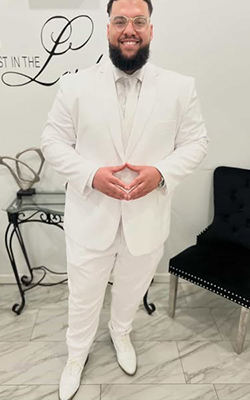
Justin Veloz-Perez
Justin was diagnosed with Crohn’s disease in 2020 and underwent ileostomy surgery in 2025.
“My symptoms started at 15 years old. I was constantly going to the bathroom and experienced fluctuating weight, bloody stool, stomach pains, ulcers, fistulas, and abscesses. After my 21st birthday, I was finally diagnosed with Crohn’s disease, and I was 26 when I received my ileostomy. My faith was challenged in the aftermath of my diagnosis. Throughout my journey, I wondered if there were other people like me in the world. Fortunately, I was blessed to find a community and organization that helps people like me, and I became much more confident. Now more than ever, I believe it is important to have a community when dealing with this life-altering experience. It is important for safety, resources, networking and, most importantly, fellowship!”
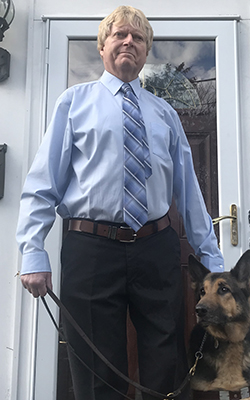
Andrew La Pointe and his dog Leroy
Andrew is totally blind and received his ostomy in 2022.
“I was diagnosed with colon cancer and my colon ruptured due to a blockage. My belly was distended and was making all kinds of noise. My doctor recommended a CAT scan which showed that I needed emergency surgery, and I almost didn’t survive. Now I have an ostomy and approximately six inches of colon left. My prognosis is good and I’m being monitored frequently.
I feel that it is important to be part of an ostomy group to connect with others and have an ongoing support system. There is nothing worse than experiencing a health challenge and having no one that understands what you’re going through.”
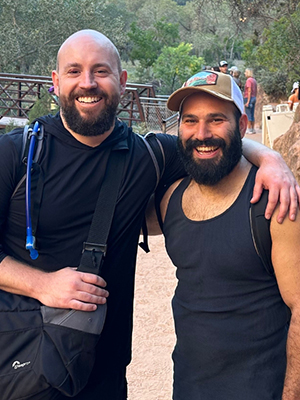
Moshe Richmond
Moshe (with me in the photo above, he’s on the right) had emergency colostomy surgery in 2019 after life-threatening complications during another minor surgery.
“The sudden reality of living with an ostomy was a profound shock, especially as I recovered from sepsis and faced new limitations. I was afraid of getting a parastomal hernia and faced challenges with eating solid food due to internal scar tissue. Desperate for answers and a path back to an active life, I reached out to an ostomy products company and had a conversation with a customer service representative about her son who was attending an ostomy conference. This was a pivotal moment for me. Despite still being weak from my hospital stay, my mom drove me to the event. At the conference, I met an ostomate named Nate who, like me, was committed to living life to the fullest. That experience changed everything; it provided not only crucial information but a vital connection to others who understood what I was going through. It gave me the confidence to reclaim my mission: to be a physical therapist and strength and conditioning coach who helps others find their own path to strength and well-being.”
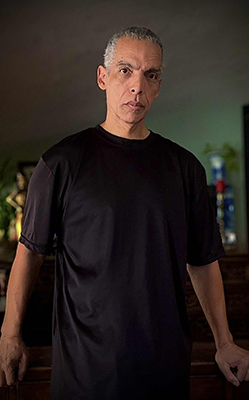
Robert Harrion
Update: Robert Harrion is the final man I interviewed for this article. He was a 61-year-old cancer survivor, who received his ileostomy in 2015. I'm devastated to report that in the time since this piece was written, Robert sadly passed away. I only knew him for a short time, but he was one of the brightest lights and most encouraging men I've ever met. He always wanted to be involved more and help anyone he could, and he radiated nothing but positive energy. My deepest condolences go out to his family and loved ones. This article is dedicated to Robert, and the example he set for all of us. Here's what he had to say…
“After several tests and procedures, I was diagnosed with a rare abdominal cancer. After my 12.5 hour, super-invasive surgery, I woke up missing some organs. One of the organs removed was my colon and my doctors created a permanent ileostomy on my lower abdomen. Once I realized that my ostomy helped save my life, I embraced it and gave it the name ‘Paco’. Over the past 10 years, I have had the pleasure of meeting other folks with ostomies. It’s amazing how there is almost always an instant connection between us, and we become family. A special bond happens when men with ostomies share stories and the challenges that we face from a male perspective.”
I have had the honor to get to know these indomitable men over the last few years. They, as well as many others, have deeply impacted my life.
To further inspire and encourage men to share their stories, I started an Instagram page called Ostomy Men (@ostomymen), which aims to bring together male ostomates from all over the world. I live in Utah, USA and the page instantly connected men from many countries, including Denmark, Brazil, and Indonesia. Each of them has a unique and inspiring story.
Over the almost four decades of my life, I would have loved to have known more men like me. We’re now on a mission to make that a reality for all men living with an ostomy!
Nate Hadlock has lived with ostomies, on and off, his entire life due to multiple birth defects. He now lives with a permanent ileostomy that he received in 2010 (which is also when he started wearing Hollister products). Nate is very grateful for his life being saved by the creation of “Simba”, his stoma. He currently lives in the red desert of Southern Utah, USA, where he is a medical billing account manager and artist. Nate has been an advocate in the ostomy community since 2018, helping new ostomy patients after surgery, raising awareness online, speaking at events and in support groups, standing up for ostomy patient rights at the US Capitol, and connecting with hundreds of ostomy friends in person.
People who provided testimonials received compensation from Hollister Incorporated. The testimonials, statements, and opinions presented are applicable to the people depicted. These testimonials are representative of their experience, but the exact results and experience will be unique and individual to each person.


